What was the first one-way street in London? The answer is Albemarle Street in Mayfair, which was made one-way in the early 19th century after becoming log-jammed with the carriages of people trying to get into the Royal Institution. And oddly enough, the trigger for their excitement was a series of science talks.
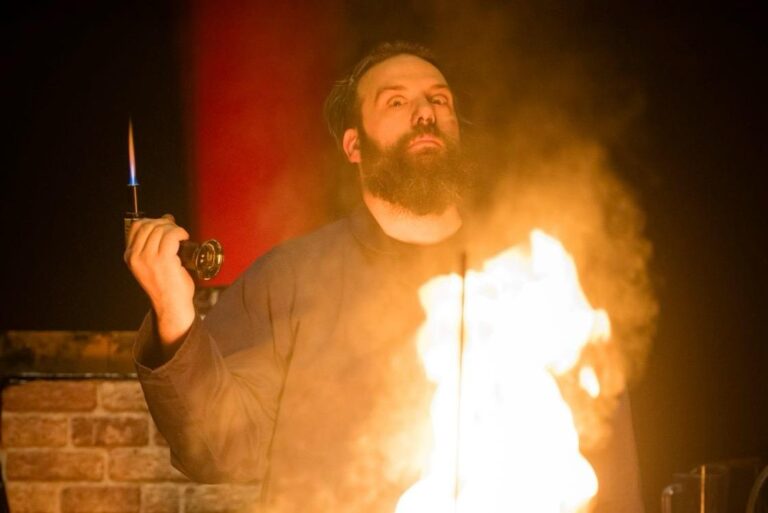
The Royal Institution was created in 1799 for the promotion of science and it has been excelling at that mission ever since. The secret to its long-term success isn’t, arguably, the charisma of its speakers, since that has been quite obvious ever since its resident scientist Humphry Davy wowed the Regency ladies in the 1810s. It’s the behind-the-scenes technical wizardry of its talented assistants—the Royal Institution’s demo team—who engineer the bangs and flashes that illustrate the speakers’ talks.
Their gifts will be on show later this month at the Christmas Lectures, which are this year celebrating their 200th birthday. Sadly, tickets are sold out for the talks by space scientist Dame Dr Maggie Aderin-Pocock (though you can catch them on the BBC after the event). But for those with grandkids to entertain this Christmas, the demo team is diligently prepping an in-person interactive video game extravaganza on the 19th, and a snow-and-ice spectacular on the 20th. You can grab tickets at rigb.org/whats-on.
Often the bridesmaids and rarely the brides, the demo team occasionally gets to step into the limelight. This week they’re being honoured with the Royal Society’s Hauksbee Prize at a ceremony at Carlton House Terrace. Devoted to the unsung heroes of science, who do their work “in support”, the award is named after a draper’s apprentice called Francis Hauksbee, who rose from obscurity in the early 18th century to become lab assistant to Sir Isaac Newton himself. And he didn’t always receive the credit he deserved. For example, after Hauksbee dropped balls of different weights and sizes from the cupola of St Paul’s in 1710 to explore the effects of air resistance, Newton’s report of the results failed to mention him by name.
So let’s name the members of the Royal Institution’s demo team: Dan Plane, the team leader, and his brave sidekicks, Michael Cutts and Feargal Barber. Between them, they know as well as Hauksbee the key to science communication, which was once summarised by a Director of the Royal Institution, Sir Lawrence Bragg, as: “Never talk about science. Show it to them”.
That’s precisely what they’ll be doing at the Christmas Lectures, which were created by Michael Faraday back in 1825. Since Faraday himself, as chance would have it, started out as a lab assistant, he understood on a deep level the show-don’t-tell principle. In one of his simplest demos, the great man used to snuff out a candle, then relight it by moving a flame close to, but not touching the wick: a graphic proof that the part of the candle that burns isn’t the wick, but the wax’s fumes.
From time to time, the demo team presents a greatest hits selection from the history of the Royal Institution, and they kick off with this candle trick. And it’s striking that they sometimes use the word “trick” to describe it, since a demo has a lot in common with conjuring. In another example, they arrange two parabolic mirrors facing one another a few metres apart. At the heart of one, they place a scrap of “flash paper” (a highly flammable nitrocellulose compound often used by conjurors). In the centre of the other, they position a white-hot cannonball. The paper ignites in an eyeball-scorching flash. This experiment—a version of one Sir Humphry Davy used to do—shows the effects of focused infra-red heat.
According to Cambridge science historian Simon Schaffer, the demos at the Royal Institution deserve credit for more than causing a sensation. They actually drove the discoveries made by the resident scientists, who “knew that what they did in the [basement laboratory] would count if, and in many ways only if, it worked upstairs” in the lecture theatre. Most notably, Schaffer points out, when Faraday found a way to make a wire rotate in an electromagnetic field, his aim was first and foremost to create a demo for the theatre. It was only incidentally that, in the process, he invented the electric motor.
I work as a science writer at the London Institute for Mathematical Sciences, an independent research centre that is based on the second floor of the Royal Institution. From that vantage, I love the idea that, at the Royal Institution, the science comms has driven the science. But whatever may be thought of the claim, it is obviously true that a really spectacular demo has tremendous power to inspire as well as instruct.
Take the double slit experiment, which was pioneered by another scientist working at the Royal Institution back in the day, Thomas Young. By passing a beam of light through two slits, and showing the interference pattern this throws up on a surface beyond, he demonstrated that light behaves like a wave—a revolutionary discovery that seemed to contradict Sir Isaac Newton’s belief that light was a particle.
A much later version of the double slit experiment showed that it’s actually more complicated: light behaves like both a wave and a particle at the same time. It is a classic demonstration of the confounding nature of quantum physics. For the actress and author Talulah Riley, merely reading about this demo was shattering. “I went to bed for three days and had a massive existential crisis,” she confessed. Transfigured by wonder, she went on to marry the rocket-maker Elon Musk, sit in on physics classes at Caltech, and ultimately become a trustee at the London Institute.
Officially, the Royal Institution’s demo team are being presented with the Hauksbee Prize for giving “spectacular science demonstrations, which are vitally important for effective education and communication of scientific concepts”. These are both worthy goals, of course. Yet as we have seen, science demos can achieve far more. They can set fire to the flash paper of people’s imagination, and in the process, transform their lives.