In a bookshop, the literary theorist Terry Eagleton once spotted a professor of philosophy perusing a book called Philosophy Made Simple. Thrilled, Eagleton crept up and murmured in his ear, “That’s a bit difficult for you, isn’t it?” The man turned to reveal that he wasn’t the colleague in question. He was a total stranger.
Intellectual snobbery, pretentiousness, and ball-shrivelling punctiliousness over points of grammar and syntax: these have all at times been part of the panoply of the pedant. For it turns out, fittingly, that the meaning of the word has become narrower over the centuries. Nowadays a pedant is someone ready to go ten rounds over the difference between “compare with” and “compare to”. Once, it could refer to any annoying scholar. Shakespeare’s Pedant in Taming of the Shrew is more of a bore than a stickler.
So hopes are high when you pick up a book entitled On Pedantry. Surely here there will be stacks of stories about the kookyness of the bookish. We might meet the philosopher Thales of Miletus, so intent on studying the night sky he fell down a well. Or Socrates pausing outside a dinner party, locked in thought for so long that he missed the meal. Perhaps we’ll come across the bishop who, after being told that, now that someone had vacated a car, there would be more space in it, replied softly, “Not more space, surely. Only less of it occupied.” Or Churchill’s response to the pedant who told him not to end a sentence with a preposition: “This is precisely the sort of thing up with which I will not put.” (Pedants might like to know there is no evidence Churchill ever said this.) Or how about The Oldie itself, which used to keep a Pedants Corner, but could never decide if it should be styled “Pedants Corner”, “Pedants’ Corner” or “Pedant’s Corner”?
Sadly, none of the above gets a mention in this largely humourless tome by the indicatively named Arnoud S.Q. Visser. To use one middle initial may be forgiven, if you want to draw a distinction between yourself and another writer who shares your name. But to use two middle initials teeters on the brink of madness.
There are nice things here. It’s pleasing to learn that Middlemarch’s pedant, Edward Casaubon, was named after the French scholar Isaac Casaubon, who died of a ruptured bladder after refusing to take a bathroom break. There’s a fine gallery of later Roman emperors, which shows their beards growing longer as an index of their intellects. And I hadn’t known about the querelle des anciens et des modernes, the intellectual spat in 1687, which saw outraged scholars wrangling over the importance of studying classical literature.
What Visser doesn’t do is place this dispute in its context. As Peter Burke argues in his Social History of Knowledge, Vol 1, a university education was once mainly about learning what the ancients had known. The idea that there were new things to be discovered, which no one had ever known, wasn’t obvious. The discovery of discovery, which arguably began in the 16th century, was perhaps the greatest discovery of all. Little wonder that, a century later, there were intellectual stragglers.
That lack of originality is a key quality of pedantry—alongside others, many of which are displayed by Prof. Visser. The first section of his chronological account, which follows the figure of the pedant from ancient times to the present day, is pretentiously named Avant La Lettre. In the third, before considering pedants in cinema, he spends a page recounting the history of movie-making, apparently to excuse his stooping to such a low art form.
Yet the toughest aspect of On Pedantry is its academic jargon. The portrayal of pedants, we’re told, is “inflected by gender”. In cinema, the pedant provides a “recognisable template to address a range of questions about power”. All this in a book that claims in its introduction to be “lively and, hopefully, at times entertaining”.
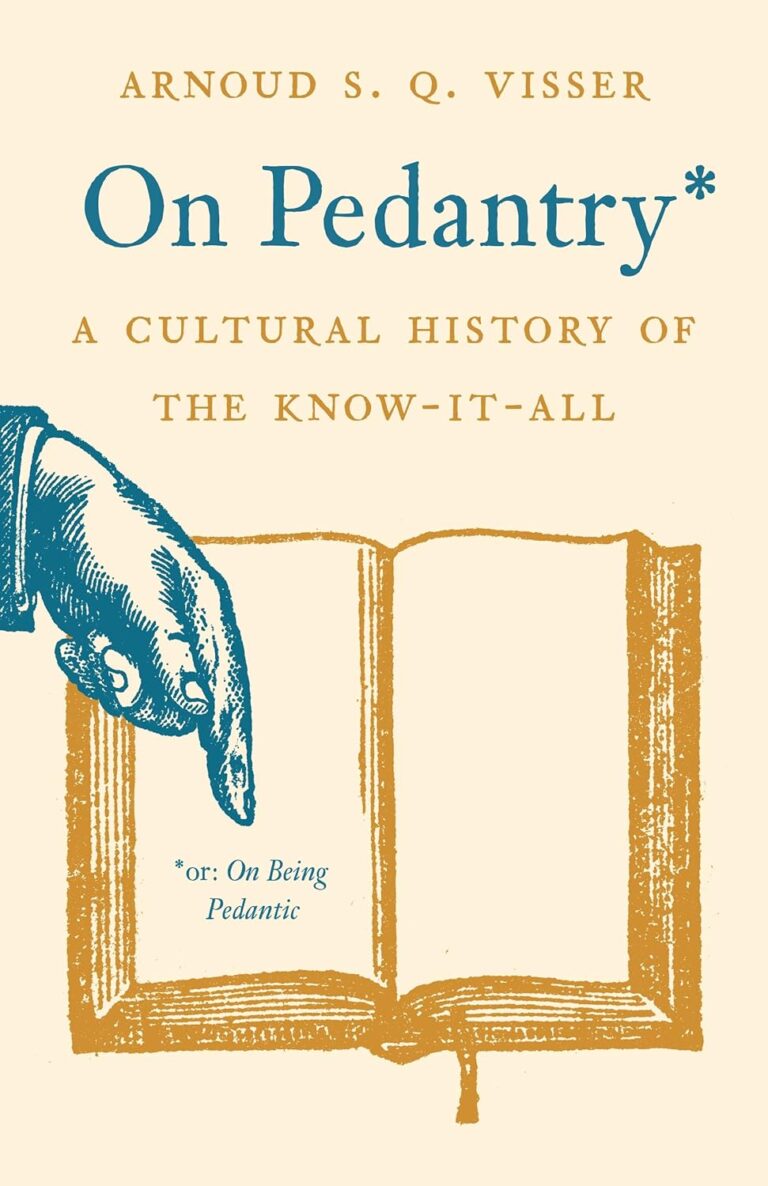
I partly blame the publishers. There, one might imagine, was poor old Arnoud S.Q. Visser quietly doing his thing at the University of Utrecht, where he is Professor of Textual Culture in the Renaissance in the Department of Languages, Literature and Communication. Then along comes Princeton University Press and persuades a man who was writing a reasonable academic book about academics to rename it On Pedantry and accept a jolly cover design. Do not be fooled, though. This is a pedantic book about pedantry, sometimes knowingly, but more often not.