When I was in my 20s and giving dinner parties every week, I came up with a couple of money-saving devices. First, no snacks. This also ensures that, by the time dinner is served, your guests are so hungry they’ll mistake almost anything for a masterclass. Second, invite people on a Monday evening, so they won’t stay too late. As my millionaire cousin likes to say: kerching!
I mention all this because one reason people don’t give more dinner parties is that they think they’re too expensive. Another is that they’re afraid of being judged. I remember once being taken aback when a guest of mine said she would never dare to give a dinner party. Jago Rackham has friends who have said something similar to him—which, by his own account, is what prompted him to write this manual, which is a terrific step-by-step guide to convening a handful of people at your home to eat, drink, and talk about this and that.
It’s not easy to pull this kind of book off without falling into Polonius-like platitudes. (Don’t invite too many people; but then again, don’t invite too few.) Rackham, who writes often in The Observer, is too smart an operator to make this mistake. Like a practiced dinner party host, his writing is simultaneously casual and solicitous. It greets you at the door, hands you the drink you were hoping for, and then ushers you into a comfortable chair, while assuring you that you won’t have to wait too long before being called to the table.
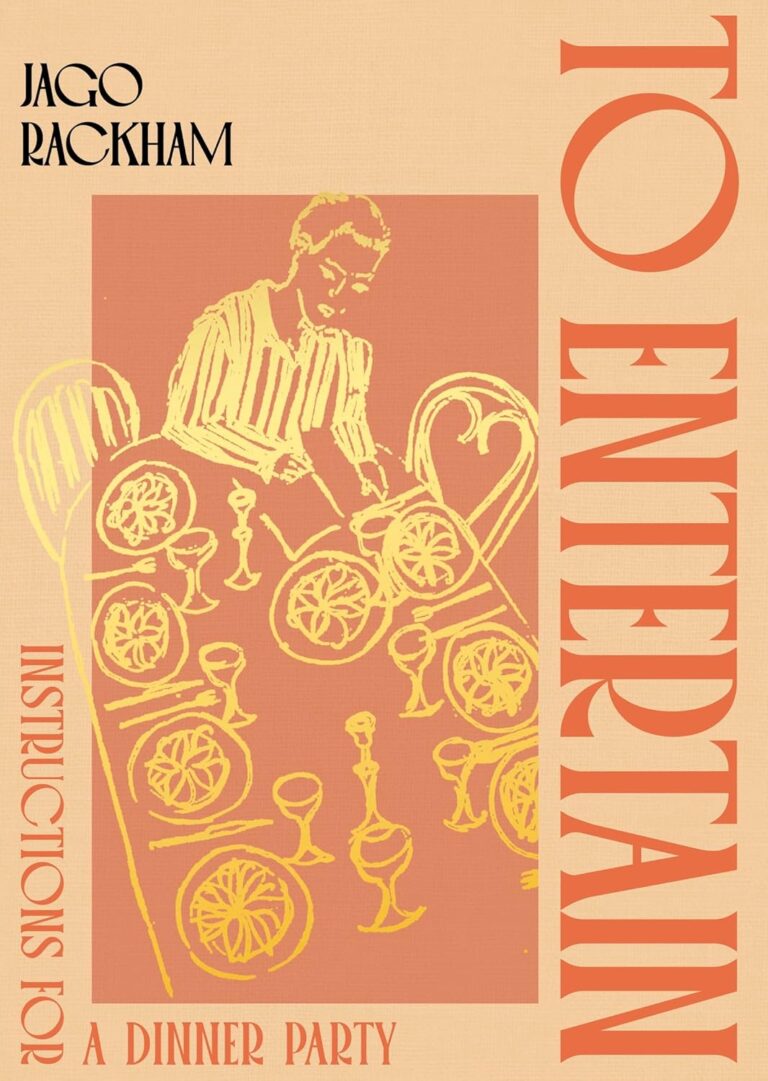
The author is an East End hipster with an artist girlfriend, but there’s nothing try-hard about his debut. Its design is lovely, with charmingly retro illustrations by Faye Wei Wei, and a cover the colour of a late summer evening. Crucially, the prose he serves up is at ease with itself: a blend of mouth-watering recipes, short lyrical reminiscences and simple practical advice.
Example one. Make it clear to friends who have children that they’re welcome to bring them. The reason it’s hard to keep dinner parties going after a certain age is that children get in the way. There’s the cost of babysitters and the hassle of booking them. So let your friends turn up en famille, and either have their children join you at the table, or if they prefer, let them lurk in another room, and watch “a film you loved when you were little”. For toddlers, I recommend the 1979 animated version of The Lion, the Witch and the Wardrobe.
Example two. If you want to impress someone—someone you have a crush on, perhaps—don’t cook anything more complicated than you normally would. In fact, Rackham suggests this as a decent rule of thumb for dinner parties generally. He also counsels producing food that communicates your personality. “If you are a neat person, able to concentrate for hours on making perfect dumplings or ravioli, then make that”. But if, as with him, “anything fiddly comes out looking like the efforts of a not quite clever child, make something rustic and easy”.
Rustic and easy are the watchwords of his recipes here, some of which I have taken the trouble to try. When my uncle Winslow came to stay, for instance, my wife prepared Rackham’s favoured version of homely chicken soup, and his sticky toffee pudding. Both were big hits. More recently, I invited a beloved friend and his effervescent new girlfriend over, and, following Rackham’s instructions, slow-cooked a shoulder of lamb in honey and wine with apples and prunes. I don’t think I have ever slow-cooked anything before. It was a revelation.
After dinner, we played one of Rackham’s endearingly hokey party games. Called Find the Glasses, it involves everyone covering their eyes, while someone stashes their glasses in plain view, but in an unexpected place. I propped mine, just visible, in a ceiling-light fitting, then watched as the others wandered around, clueless—until it occurred to someone to glance up. For me, this was surprisingly hilarious, partly because I spend most of my life searching for my glasses. For my wife, it was less so, because she spends most of her life finding them.
The author occasionally lets his personal philosophical views peep through. He’s not a fan of organised religion. As for the aristocracy, he would like to “destroy” everything about them, except one thing: “the comfort they have in their preferences”. This is also, of course, one of the key-notes of To Entertain, as it must be of any good how-to book. I found the experience of reading it so convincing—not only as a guide to giving dinner parties but as a defence of their existence—by the end I felt as if I had had a long-lost pair of glasses restored to me.