In the early 9th century AD, the leader of the Bulgars, Krum the Fearsome, defeated the Byzantines in battle. He harvested their emperor’s skull, lined it with silver and used it as a drinking cup. No wonder he was known as Krum the Fearsome.
Soon afterwards, the great Krum seized Nessebar. It was one of countless changes of ownership of this extraordinarily beautiful little town on the Black Sea coast.
A UNESCO World Heritage Site, the old town of Nessebar is a Balkan gem, crammed with so many Byzantine churches that some say it has more churches per capita than any other town in the world. Its history is fascinating, its rooftops terracotta, its streets satisfyingly cobbled. Yet it remains virtually unknown.
That may partly be because it has been overshadowed by the nearby Sunny Beach, which is famously—or infamously, depending on your point of view—one of the cheapest beach destinations in Europe. That affordability comes at a cost. While a few tourists explore the labyrinth of Nessebar, hordes of sunburnt British teenagers prefer to swarm over the sands of Sunny Beach. Towering concrete hotels have reared up within sight of these intricate Byzantine shrines. While the latter shelter harmonious medieval icons of the Madonna and Child, the former overlook raucous wet T-shirt competitions at Happy Hour.
However, if you stay in the old town itself, you can avoid the hurly-burly. During my ride to Nessebar, my taxi driver Filip tells me that when you visit the place, “you travel back in time and sense the life of your ancestors and the atmosphere back then”. What makes it unique, he says, is that it has been occupied by four different peoples, each of which left their mark: the Thracians, the Romans, the Bulgarians and the Ottomans.
The town certainly makes a fitting focal point for national pride. Admittedly, the area it covers is small, consisting of a tiny peninsula. You can walk from one side to the other in five minutes. Yet the switchback streets are easy to get lost in. And there’s so much to see that you could spend days here without venturing further afield.
The biggest draw is Nessebar’s many churches, each of which has a charm of its own. The first I enter, the thousand-year-old Church of St John the Baptist, boasts icons of the Virgin Hodegetria. The Virgin Mary points with her palm at the baby Jesus, as if introducing him. The word “Hodegetria” comes from the Greek, meaning “she who shows the way”.
The outside of the second church, the Church of St Paraskevi, is decorated with lunettes of coloured stones arranged in patterns of fishbones, chessboards and shining suns.
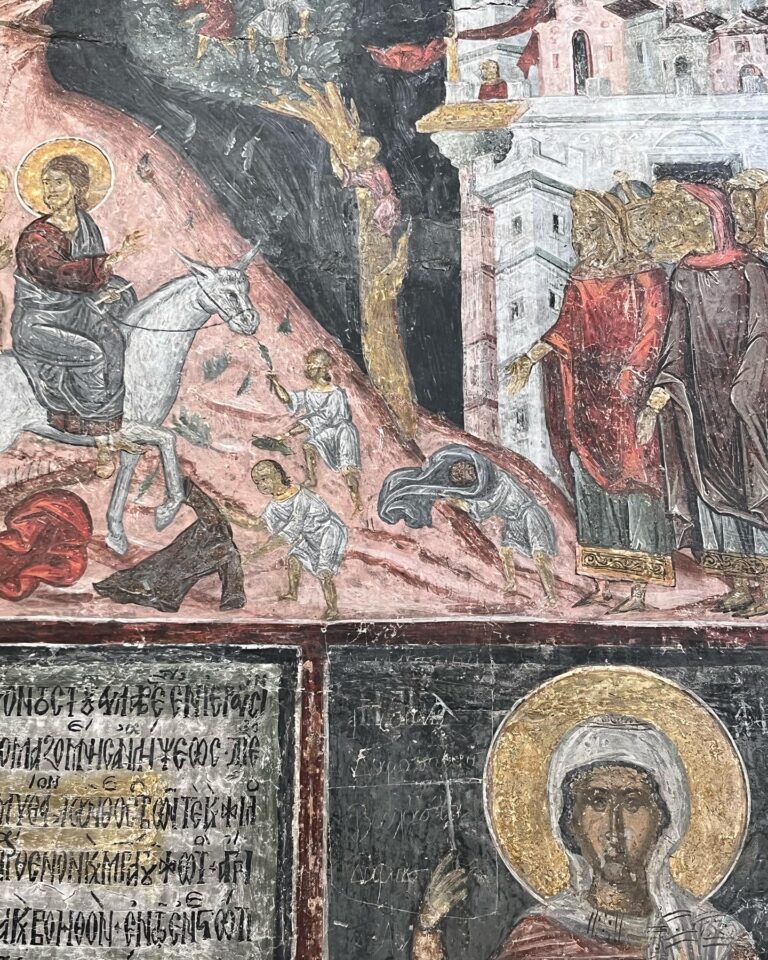
The inside of the third church I visit, the 17th century Church of the Holy Saviour, is one of the most beautiful things I have ever seen. The murals that cover its walls envelop you in a blanket of colour and artistry. In a panel depicting Jesus’s entry to Jerusalem, I particularly enjoy the depiction of one worshipper, who is taking off his cloak to lay it down in the path of the Messiah. But the poor chap seems to have got it tangled around his head. It’s a homely detail in a serious work of art.
It’s clear that Nessebar has been prosperous. In fact, it was one of the first places on the planet to mint its own coins. Drop into the archaeological museum and you can admire, as well as barnacle-encrusted amphorae and some shattered statues, ragged pieces of bronze and silver, which date back to the 5th century BC.
When it came to uncovering the secrets of its history, one woman who showed the way—a kind of intellectual Hodegetria, you might say—was the underwater archaeologist, Lyuba Ognenova-Marinova. In traditionally conservative Bulgaria, she led 15 expeditions from the 1960s onwards. The story goes that Ognenova-Marinova was at first terrified of diving. Yet once she was shown evidence that amphorae littered the sea bed, she didn’t hesitate. Her work uncovered a hexagonal tower, a theatre, and a temple to Zeus and Hera. Late in life, she was given the Order of St Cyril and St Methodius in recognition of her achievement.
You too may feel like an explorer as you navigate the little back-streets, admiring the wooden Ottoman houses, and remembering that, not so far away, there are people who mainly came for the cheap booze.
These alleys conceal their share of antique shops, filled with almost anything you could imagine. It even occurred to me I might find a skull-shaped drinking cup in honour of the great Krum. Sadly, the search proved fruitless, but I did pick up a silver bottle opener shaped like a dolphin.
Nessebar has several excellent restaurants, unspoilt by the tourists that dominate the streets in July and August. In the oddly named Hemingway restaurant—I can find no evidence that the writer ever visited the town—I tuck into an excellent chicken kebab, washed down with local Kamenitza beer and topped off with a glass of rakia, a Bulgarian fruit brandy.
It carries a kick, but you can soften your hangover with a morning dip in the Black Sea. There’s a lovely beach on the point of Nessebar, a perfect spot for relaxing with a book and letting yourself be overcome by sloth. As I arrived in Nessebar along the man-made isthmus, I noticed a towering modern statue of Noah releasing a dove. It provided a fitting symbol of the feeling of calm that settles on you after a day or two in this peaceful Balkan enclave.