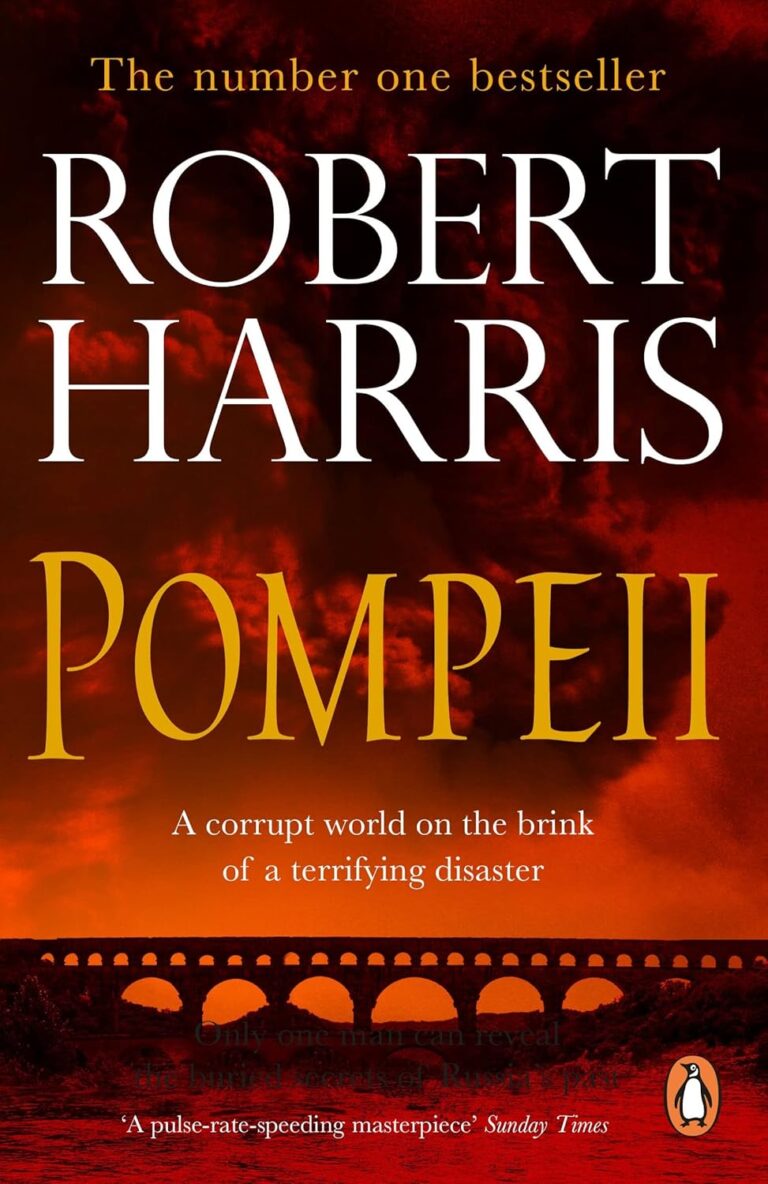
Dramatic irony originated as a concept in studies of Greek tragedy and was located in the space between the ignorance of the characters on stage, who grasped at the future only through prophecies and omens, and the knowledge of the audience members, who knew their myths—who knew that Medea, to take one example, was going to kill her children, or that Oedipus, to take another, had relationship issues. The interest lay in the details, in how these catastrophes would work themselves out. The same could be said about a novel entitled Pompeii, set in AD79. We have a fairly clear idea of how it’s going to end.
Attilius, a young Roman engineer, has been assigned to the post of aquarius in charge of the Aqua Augusta, the aqueduct that feeds water to the major towns along the Neapolitan coast. He has to investigate the mysterious disappearance of his predecessor, Exomnius; enlist the aid of Pliny the Elder, the admiral in charge of the fleet at Misenum; circumvent the hostility of Ampliatus, the brash parvenu who essentially runs the show in that part of Italy; and decide what, if anything, to do about Ampliatus’s beautiful daughter, Corelia, who is destined for a loveless marriage to a lascivious local magistrate. Most important of all, he has to find out what has caused the break in the Aqua Augusta, which appears to have developed a fault somewhere on the slopes of Mt Vesuvius.
It was a bold idea of Robert Harris’s, and a brainy one, to cast as the protagonist of his volcanic thriller an expert on water, but it does mean that he has to try to make the concerns and expertise of an aquarius gripping to read about, and it must be reported that he does not altogether succeed in this task. It’s hard to maintain much enthusiasm when being told for the third time about the results obtained by mixing the correct proportions of puteolanum and lime. Moreover, the eruption of the volcano is reserved for the last third of the book. As with Ang Lee’s Hulk, the long wait before the first sighting of the monster is a little wearisome. When Pompeii is made into a film, as is presumably the plan, the excitement engendered by the success of Gladiator will only carry it so far. The director should not make the mistake, as Harris does here, of postponing until too late the appearance of the show’s star.
That said, the early pages of the book are enlivened by some nice touches. I particularly enjoyed the excesses of Ampliatus, a character based, as Harris admits, on Petronius’s Trimalchio (who was also, for those interested in such things, the inspiration for Jay Gatsby). At one point we read that Ampliatus is motivated to throw a slave to his moray eels by the theory that eels which have fed on human flesh possess a particularly piquant flavour when they are served up in their turn. Later he tests the truth of this, and is disappointed.
Despite the clichés in Harris’s prose (‘he could not take his eyes off her’; ‘Ampliatus’s voice cut across the table like a whip’), it is worth reading on for the novel’s denouement, which is genuinely thrilling. Some of the details are taken from Pliny the Younger’s famous letter to Tacitus, in which he described the stoical behaviour of his uncle, Pliny the Elder, in his final hours: how, for example, he went to sleep while everyone panicked around him, and snored very loudly. Some of the details are Harris’s own. We know fast-moving lava will bury the city. We suspect our hero will escape with his beloved. What we are less sure about is the minor question of how.