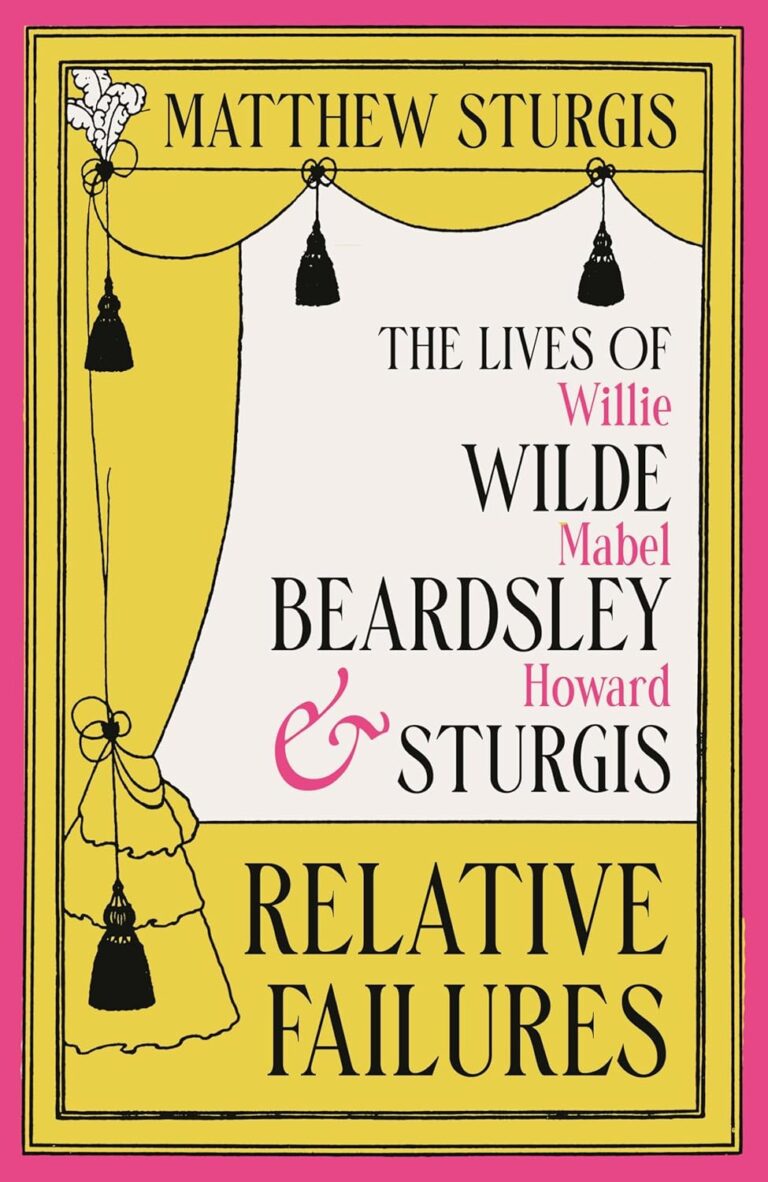
Some while back, the literary biography industry slowed as it began to run out of subjects to write about. It found a new avenue in studies of the wives of writers. Since then, it has broadened out into parents. Now Matthew Sturgis further extends the remit to brothers and sisters with this beguiling biographical triptych.
Sturgis is the author of acclaimed biographies of Oscar Wilde and Aubrey Beardsley. So it’s no surprise that his first two choices are their siblings, Willie and Mabel. Keen-eyed readers will notice he shares a surname with the third subject here, Howard Sturgis, brother of the popular novelist Julian Sturgis. Turns out, the two Sturgises were great-great-uncles of our current author, so he has a familial interest.
These choices, and this running order, have the effect of front-loading the book. Few have heard of Julian Sturgis now, and however much you may admire the sinister certainties of Aubrey Beardsley’s black-ink illustrations, Oscar Wilde towers over them both. As well as a figurehead of the gay rights movement, he has become an emblem of the oppressed artist due to his imprisonment (two years’ hard labour for, in effect, being gay). He is also arguably the only writer in English to have produced a great poem, a great novel and a great play.
Inevitably, then, the first section of Relative Failures, which covers the life of his older brother, Willie, carries the most interest. However, the question hovers over these pages, as it does over the others, as to whether the attention is merited. In Willie’s case, the answer is a resounding yes.
Like a figure from one of the Gothic doppelgänger novels of the period, Willie was the spitting image of Oscar. Tall, talkative and big-boned, he was the clever one as a kid. He was the first to publish a poem: a translation of something by Victor Hugo in 1873. He was the first to make his mark in journalism. His facility for turning out eight hundred words on anything you cared to mention, at the drop of a hat, astonished even Oscar. He was also the first to score a theatrical success, with his droll adaptation of F.E. Anstey’s popular novel The Tinted Venus, which became a hit at the Prince of Wales Theatre in Liverpool in 1885.
By then, however, the eclipse had begun. Willie once confessed to his frustration at being dubbed “‘the brother of Oscar Wilde’–a reflex celebrity”, as he noted, “which, while it is one of my proudest privileges, is yet so destructive of my own identity that it has become comically irritating”.
That slow annihilation was to be the story of his life. His very fluency as a journalist left him with too much time in the afternoon for drinking. He charmed girls and jilted them with equal ease. Bankrupted early, he became convinced a strategic marriage was the answer to his problems and in 1891 wed the wealthy widow of a New York press magnate. She soon grew tired of him, confiding to a friend that, owing to his drinking, he was of no use to her “either by day or by night”. The divorce came through in 1893.
By now, notwithstanding the rumours that circulated about Oscar’s private life, Willie was the black sheep of the family. Sturgis doesn’t say it, but the older Wilde boy arguably inspired the idea of the reprobate brother in The Importance of Being Earnest, and perhaps even the cautionary portrait in The Picture of Dorian Gray.
Where he finally went wrong was in letting his envy of his brother catch fire. This began when he reviewed his plays snidely in the press, declaring, for example, that Oscar’s bandying around so many posh names in A Woman of No Importance made him feel “fratricidal”. Then it emerged that, in New York, Willie was known for his hilarious impersonations of Oscar, and had declared that he could easily write plays that were just as successful. All he had to do, he said, was grab a second-hand copy of the Duc de la Rochefoucauld’s Maxims and then lace his dialogue with hoary one-liners, as Oscar did.
Oscar cut off all contact. When his own downfall came in 1895, Willie played the concerned older brother. As Oscar remarked to a friend, “My poor brother writes that he is defending me all over London; my poor, dear brother, he could compromise a steam-engine.” Indeed Willie’s defence of Oscar involved declaring to anyone who would listen, “Oscar was not a man of bad character: you could have trusted him with a woman anywhere.” He died of alcoholism in 1899.
After such heady stuff, the life of Mabel Beardsley can’t help paling by comparison. She was beautiful, with a shock of red hair, and an actress, although not especially successful. Her greatest achievement was the love and loyalty she inspired in others. W.B. Yeats visited her deathbed and wrote four poems in her honour.
“At a psychological level,” Sturgis states in his introduction, “it is interesting to chart how the success of one sibling changes a family dynamic.” Oddly, though, he doesn’t seem interested in that theme. He gives us three straight biographical studies which, thanks to the elegance and precision of his prose, he pulls off with aplomb. Nevertheless it’s curious to find no mention of sibling de-identification: the syndrome by which one child may define themselves in opposition to another. In the section on Howard Sturgis, for example, we learn of his distress when his older brother Julian died. “You know what a bad brother I was to [Julian] in old days,” he writes to a friend. That friend may know, but we don’t, as we haven’t been told.
A fastidious Eton-educated man of letters who seems when young to have resembled the actor Dan Stevens, Howard Sturgis himself wrote three novels that have their advocates. Yet he is mainly notable for the extraordinary charm he held, especially, but not exclusively, for other gay men. Henry James once wrote to him, “I repeat, almost to indiscretion, that I could live with you. Meanwhile I can only try to live without you.”
Reading this highly enjoyable book, I was reminded of Oscar Wilde’s dictum that he had put only his talent into his work, but his genius into his life. To an extent, this is true of most of us. We haven’t produced works that will be appreciated in one hundred years’ time. Our greatest achievement, if any, is who we are. That’s what gets lost, most instantly, at death–unless we are lucky enough to have a biographer like Matthew Sturgis to swoop in and retrieve it.