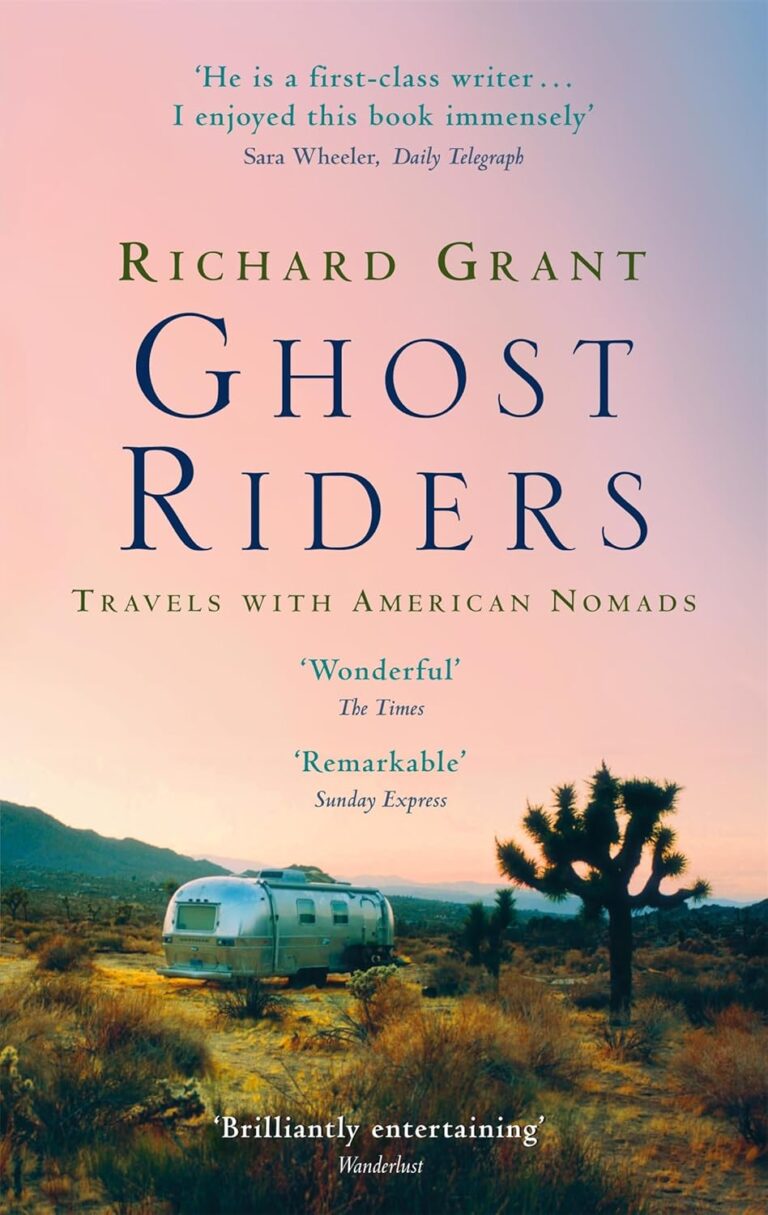
“Comes over one the absolute necessity to move.” Thus the opening sentence of D.H. Lawrence’s Sea and Sardinia, the best of his travel pieces. What is it that compels certain people to scorn hearth and home and return relentlessly to the open road, or desolate places where no roads go? Some possible answers are explored in Ghost Riders.
Richard Grant is an Englishman who has spent his adult life wandering the wilds of America. His book is as much a personal statement as an impersonal investigation: he hopes that by interviewing tramps and bullriders, RV retirees and New Age travellers, and by tracing the figure of the American nomad back to ecstatic poets and taciturn frontiersmen, taking in the wandering indigenous tribes of recent and remote history, he may come to a better understanding and a stronger justification of his own inability to stay in the same for more than a few weeks at a time.
The book, like its subject, has a tendency to ramble; there are places one would like it to go and it never does; but its diversions always end up somewhere interesting. The story of the massacre of the buffalo in the nineteenth century may be well known to American schoolchildren, but is probably less so to an English readership. White hunters killed as many as 125 million over thirty years. For a long time the Indians refused to accept the extinction of their main source of food. preferring to believe that the buffalo had emigrated to Canada, or else taken refuge underground.
The urge to roam can be explained in terms of conscious and subconscious stimuli. On the one hand, there is a great history of human nomadism, which may, as Bruce Chatwin argued, have left its traces in the modern psyche–why are babies lulled to sleep by being rocked, if not because it reproduces the effect of being carried by a tribe on the move? On the other, citizens of what have conventionally been regarded as the world’s more civilised societies have seen superior virtues in the noble life of the nomad. John Gray who advocated an animalistic existence in his recent Straw Dogs, must be an admirer of the Apaches, who, Grant informs us, learnt to tread so softly that they could approach a bear or wolf and touch it with the lightness of a leaf, before melting away again undetected into the forest.
In the 18th and 19th centuries the white frontiersmen adopted Indian customs, some going so far as to scalp their enemies. They grew their hair long and greased it with bear tallow, and dressed in deerskin moccasins, linen hunting shirts and breechclouts, a type of trouser that “left their upper thighs, hips and a portion of their buttocks uncovered”. Such practices (with the exception of the scalping) can be seen in a corrupted form today, in the heritage get-togethers such as Rendezvous Days, where everyone dresses in deerskin and laments the passing of a better time.
This theme of corruption suffuses Ghost Riders–the idea of there having been a golden age, then silver, from there into bronze, and finally into the plastic age in which we live. The Native Americans had their lands taken, were corralled into reservations, and received the whisky bottle as their compensation. Where once there were the likes of Natty Bumppo, now we have the drug-addled Rainbow family and the circuit of bullring testosterone junkies.
For the ideal American nomad, the author has to look back into history. The prototype was Alvar Nunez Cabeza de Vaca, a conquistador whose incursion into Florida in 1528 ended in disaster and who survived for almost ten years thereafter, being enslaved by the Indians, escaping and trading with them, and finally being hailed by them as a god. When he returned to Spain he was shocked by the brutality of his compatriots and could not bear the feel of shoes on his feet, of clothes next to his skin, or of sleeping in a bed. A few years later he succeeded in being chosen for an arduous expedition to Paraguay.
The Odysseus Syndrome (whose sufferer is so scarred or strengthened by his travels that it becomes impossible for him to rest) was also experienced by the mountain man, Joe Walker. He led an unprecedented trek across the Great Plains to California in 1833, and when he got there was offered 30,000 acres of free land by the Spanish governor. He turned it down, preferring the life of a wanderer.
The book is not without flaws. Some of the glorifications of freedom and of the beauty of the wilderness come across as embarrassing, and have been done better by others (vide Kerouac). The decision to limit the scope to North America is a little frustrating. But Richard Grant’s clear-sightedness regarding the less admirable customs of the Indians (the predilection of some tribes for torture, for example, and for allocating the back work to their women and old men) and his awareness of the selfishness of the solitary life strengthen the force of his eulogies. In our sedentary, possessionist age, Ghost Riders seems salutary and inspiring. Comes over one the absolute necessity to approve.