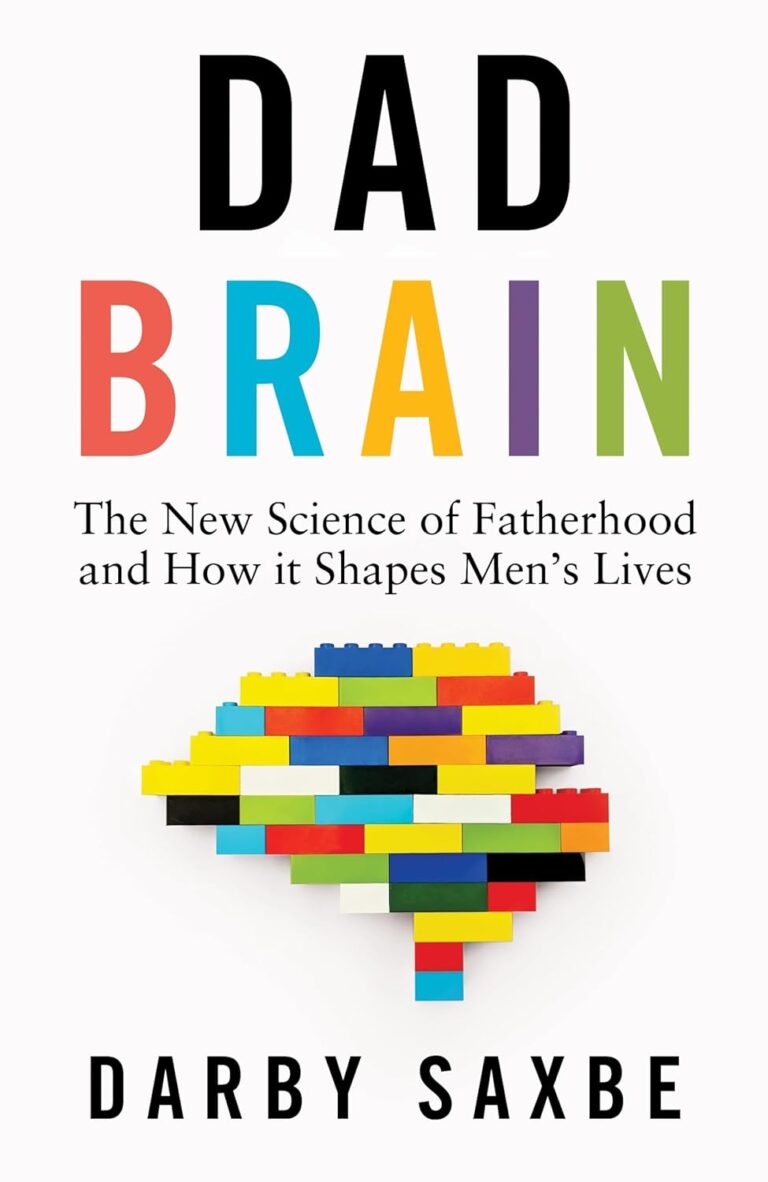
Asking the father of a newborn to comment on a book called Dad Brain is a bit like getting an alcoholic to write a review of The Lost Weekend, or a madman to dictate a critique of American Psycho from the confines of his straitjacket. If the title’s implication is true, I thought, my IQ may have taken a hit since my daughter Isobel arrived late last year. Might I be incapable of reviewing anything, let alone a book about my incapability?
Yet when Literary Review sent me this accessible account of the latest science on fatherhood, I wearily donned my sling, crammed the weeping Isobel into her marsupial pouch and got reading. And to my relief, I learned that I probably shouldn’t worry. I say “probably” because there isn’t all that much scientific data about fatherhood. That is the USP of this book as well as its weakness. Darby Saxbe, a professor of psychology at the University of Southern California, was involved with one of the few studies of the changes that fatherhood produces in male brain structure. It revealed that men’s brains get 1 per cent smaller. Whereas mothers’ brains shrink in several places, fathers lose capacity exclusively in the cortex, the area that enables humans to think ahead. How does this work? Is 1 per cent a lot to lose or a little? I’m not clear on the answers to these questions even now.
While reading this book, I was repeatedly vomited on by my daughter, and I reflected that we were each, in our own way, producing reviews. As I mopped at my thigh with sodden kitchen paper, I realised that my approach to this task was that of a Method writer, viscerally immersing myself in my subject. And for the record, I don’t feel any more stupid than I normally do. Rather the opposite, in fact. When you have three children (in my case, aged zero, three and eleven), you need to get good at problem solving. After my second son, Robert, was born, I did a lot of book reviewing in the silent wastes of the night, with Robert balanced on one arm, a book at the end of the other and a bottle clamped under my chin.
There is indeed some evidence here, which is fun to consider, that the physiological changes of parenthood, which seem dismaying, help us to be better parents. As well as my 1 per cent brain loss, I have supposedly also suffered a tragic drop in testosterone. Saxbe argues that this may make me tolerant of my crying child.
The first half of Dad Brain is dedicated to the science of fatherhood. It’s interesting but frustrating owing to the limited evidence. The second half focuses on the personal experiences of fathers, and this, for me, is the more valuable part. Over the past seventy-five years the division of childcare between mothers and fathers has been shifting. In America, we learn, fathers now do four times as much childcare as they did in 1965. The Covid crisis had an effect. Now that a lot more fathers work from home, they do more childcare too. The average millennial father devotes 2.5 hours more to childcare per week than he did before the pandemic.
But as the author points out, there is still a hell of a long way to go. I have anecdotal evidence to support this. Before Robert was born, I reluctantly attended eighteen hours of NCT classes. The fathers-to-be I met all seemed like decent guys, yet once their babies arrived, their contributions were risible. That, at least, has been the report of their spouses, relayed to me by my wife. There was the dad, for example, who never changed a nappy. The one who only agreed to try putting his own child to bed after she was three months old. (Having succeeded, he executed an elaborate bow to his wife, much to her fury.) The one who never drops his daughter off at school, because he says he finds it too upsetting.
I suppose I’m guilty too. I have done more childcare with each child, which leaves me wondering if I was bit rubbish first time round. As Saxbe intriguingly notes, men tend to measure their contributions against those of their own fathers. By this metric, they score well. Women are conscious only that their men are doing less than half.
Becoming a father is a massive life change. It is the transition, which the Danish philosopher Søren Kierkegaard described, from the aesthetic stage, which is mainly about yourself, to the ethical stage, which is mainly about other people. Anyone due to become a dad would do well to read one book about it at least, while their wives scale their tottering tower of manuals. This nicely done primer makes a reasonable start, since it warns you of the challenges that lie ahead—not least how enraged your wife will be if you fail to man up.