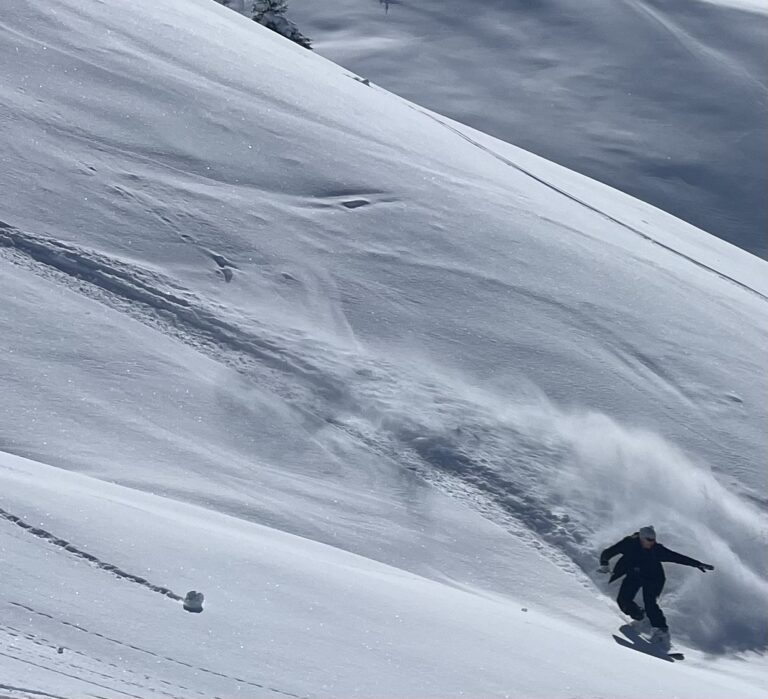
“You ski like Mussolini,“ remarks my guide, Thomas Dietiker, as we grab a cup of coffee in a mountain restaurant. “Because of my commanding stance?“ I suggest. He shakes his head. “No,” he replies. “Because you gesticulate, like someone giving a speech from a balcony.”
I’m surprised to find myself compared to Italy’s wartime dictator. But in the circumstances, I’ll take it. Because we are in the middle of my first ever official day of off-piste and it’s spectacular. Of course, I have messed about off-piste before, sometimes precariously. But Thomas takes me far from the beaten track, and we have all the avalanche kit: the transceiver, the shovel, the probe.
The sun is bright in a large and cloudless sky. There is nothing as far as the eye can see except deep light white powder.
This is just one of the highlights of my trip to the Swiss ski resort of Davos, whose history goes back further than most. It was to Davos that tuberculosis patients flocked in the 19th century, when the condition was responsible for one in four deaths in Europe. Many stayed at the stately sanitarium called the Schatzalp, which overlooks the town, hoping the clean air would help. The place—now a hotel—inspired Thomas Mann to write his steep climb of a novel, The Magic Mountain, which this year celebrates its 100th birthday.
When I pay the Schatzalp a visit, I’m struck by the glorious air of neglect. Paint peels. Furniture fades. In the antique cage lift, there’s a special door at the back, through which orderlies smuggled out bodies, in order not to dismay patients who were still clinging to life.
If this all sounds a bit morbid, fear not. There are livelier pleasures to be had in Davos, too. One evening, I go to an ice hockey match: Davos v Lausanne. Turns out, ice hockey is thrilling to watch. I’m not sure of the rules, but as the little rubber puck zips across the ice, and the players do their best to kill one another, I’m on my feet and roaring along with the rest.
Is it sacrilege to say that one ski resort often seems like another? They all have some stately backdrop of mountains, the same exhausted chalet girls and air of a permanent party. But Davos is different in that it has a history distinct from skiing. It’s also bigger than most—the highest city in Europe, in fact, at 1,560m. And it’s the scene, of course, of the World Economic Forum, where political bigwigs and corporate honchos gather once a year. I’m happy to say I miss this jamboree.
Which means it’s all rather peaceful as I explore the medieval Rathaus (town hall), with its gorgeous freestanding ceramic-tiled oven. Ditto the Kirchner Museum. Turns out Davos has its own Picasso—the German artist Ernst Kirchner, whose expressionist paintings the Nazis dubbed “degenerate”. He fled to Davos and ultimately killed himself. But his glowing masterpieces have lost none of their power. It’s another of Davos’s surprises, to go with the ice hockey and the Mussolini comparisons.